
There are two broad categories of ICCs. Memory cards contain only non-volatile memory storage components, and perhaps dedicated security logic. Microprocessor cards contain volatile memory and microprocessor components. A smart card, chip card, or integrated circuit card (ICC) is any pocket-sized card with embedded integrated circuits.
Smart cards can provide identification, authentication, data storage, strong security authentication for single sign-on (SSO) and application processing.
Physical, electrical and other characteristic of Smart cards are described by the ISO/IEC 7810 and ISO/IEC 7816 series of standards.
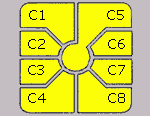
Smart Card (SIM Card) pinout
| Pin | Name | Description |
|---|---|---|
| C1 | VCC | +5 VDC power supply input (optional use by the card) |
| C2 | RESET | Reset signal, used to reset the card's communications. Either used itself (reset signal supplied from the interface device) or in combination with an interal reset control circuit (optional use by the card). If internal reset is implemented, the voltage supply on Vcc is mandatory |
| C3 | CLOCK | Provides the card with a clock signal, from which data communications timing is derived |
| C4 | RESERVED | AUX1, optionally used for USB interfaces and other uses. |
| C5 | GND | Ground (reference voltage) |
| C6 | Vpp | Programing voltage input (optional). This contact may be used to supply the voltage required to program or to erase the internal non-volatile memory. ISO/IEC 7816-3:1997 designated this as a programming voltage: an input for a higher voltage to program persistent memory (e.g., EEPROM). ISO/IEC 7816-3:2006 designates it SPU, for either standard or proprietary use, as input and/or output. |
| C7 | I/O | Input or Output for serial data (half-duplex) to the integrated circuit inside the card. |
| C8 | RESERVED | AUX2, optionally used for USB interfaces and other uses. |
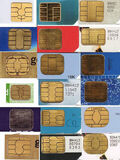
Please note that there are great variations in connector shape:
Image from Wikipedia:

The dialogue between the interface device and the the card shall be conducted through the consecutive operations:
- connection and activation of the contacts by the interface device
- reset of the card
- answer to reset by the card
- subsequent information exchange between the card and the interface device
- deactivation of the contacts by the interface device
Interfacing smart card isn't a simple task. Here is the Smart card to PC interface adapter cable scheme.
 correct
 incorrect