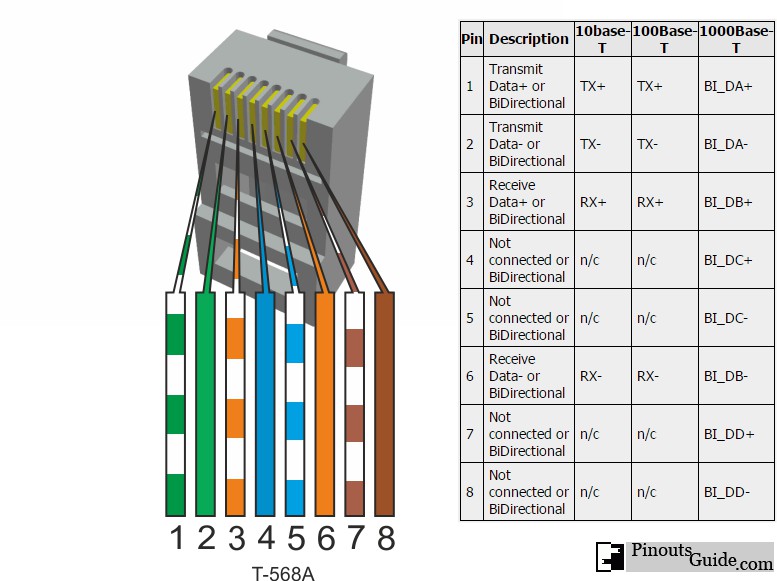

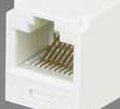
Nowdays ethernet is a most common networking standard for LAN (local area network) communication, officially standardized by IEEE standard 802.3. Nowdays ethernet runs at 10Mbit(Ethernet), 100Mbit (Fast Ethernet RJ45 connection), 1Gbit (Gigabit ethernet) or 10Gbit per second. It was originally developed by Xerox Corporation in cooperation with DEC and Intel in 1976. Ethernet uses a bus (old coaxial cable) or star topology (standard UTP cable). Most ethernet networks use unshielded twisted pair (UTP) cable. Category 5 (CAT5) cable widely used, but other variations are available. EIA/TIA specifies RJ-45 connectors - properly called 8P8C - (ISO 8877) for UTP (unshielded twisted pair) cable. (RJ45 refers to a set of connectors beyond the 8P8C standard but the former has replaced the latter in common usage).
| Pin | Description | 10base-T | 100Base-T | 1000Base-T4 |
|---|---|---|---|---|
| 1 | Transmit Data+ or BiDirectional | TX+ | TX+ | BI_DA+ |
| 2 | Transmit Data- or BiDirectional | TX- | TX- | BI_DA- |
| 3 | Receive Data+ or BiDirectional | RX+ | RX+ | BI_DB+ |
| 4 | Not connected or BiDirectional | n/c | n/c | BI_DC+ |
| 5 | Not connected or BiDirectional | n/c | n/c | BI_DC- |
| 6 | Receive Data- or BiDirectional | RX- | RX- | BI_DB- |
| 7 | Not connected or BiDirectional | n/c | n/c | BI_DD+ |
| 8 | Not connected or BiDirectional | n/c | n/c | BI_DD- |
Length of CAT5 cable runs should not exceed 100 meters.
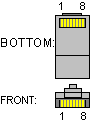
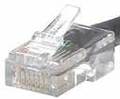
Please note that it is very important that a single pair be used for pins 1 and 2; 3 and 6, 4 and 5 (if used), 7 and 8 (if used) in any common straight-thru UTP Cat5 network cable. If not, performance will degrade. Also note that TX & RX should be swapped if two computers are connected without switch/hub and for connecting some devices without MDI-X autosensing (see UTP crossover cable).
 correct
 incorrect